Management of International Health and Safety
This course delivers a complete, work-ready understanding of how occupational health and safety (OHS) is managed to international best-practice standards.
Introduction to International Health & Safety Management
This foundation module sets the scene for the whole course. Before we study management systems, risk assessment or monitoring, we need a shared language and a clear reason for the work. In this module you will learn what occupational health and safety actually means, how the ideas of safety, health and welfare differ, how hazards turn into harm, who is responsible, and why every organisation — anywhere in the world — must manage health and safety in a planned, systematic way.
- Define occupational health and safety and explain why it matters in every workplace.
- Distinguish clearly between safety, health and welfare.
- Explain the relationship between a hazard, a risk and harm, and where control fits.
- Describe the roles of managers, supervisors and workers in keeping people safe.
- Explain why health and safety must be managed systematically rather than informally.
This lesson introduces the meaning of occupational health and safety and explains why it is important in every workplace. By the end, you will understand the role of safety management in preventing injury, ill-health, death, property damage and business disruption.
Occupational health and safety (OHS) — also written as occupational safety and health (OSH) — is the discipline concerned with protecting the safety, health and welfare of people at work. It is a broad, multi-disciplinary field that draws on engineering, medicine, law, psychology and management. Its central purpose is simple to state but demanding to achieve: to make sure that people can do their jobs without being injured, made ill, or killed by the work they do or the environment they do it in.
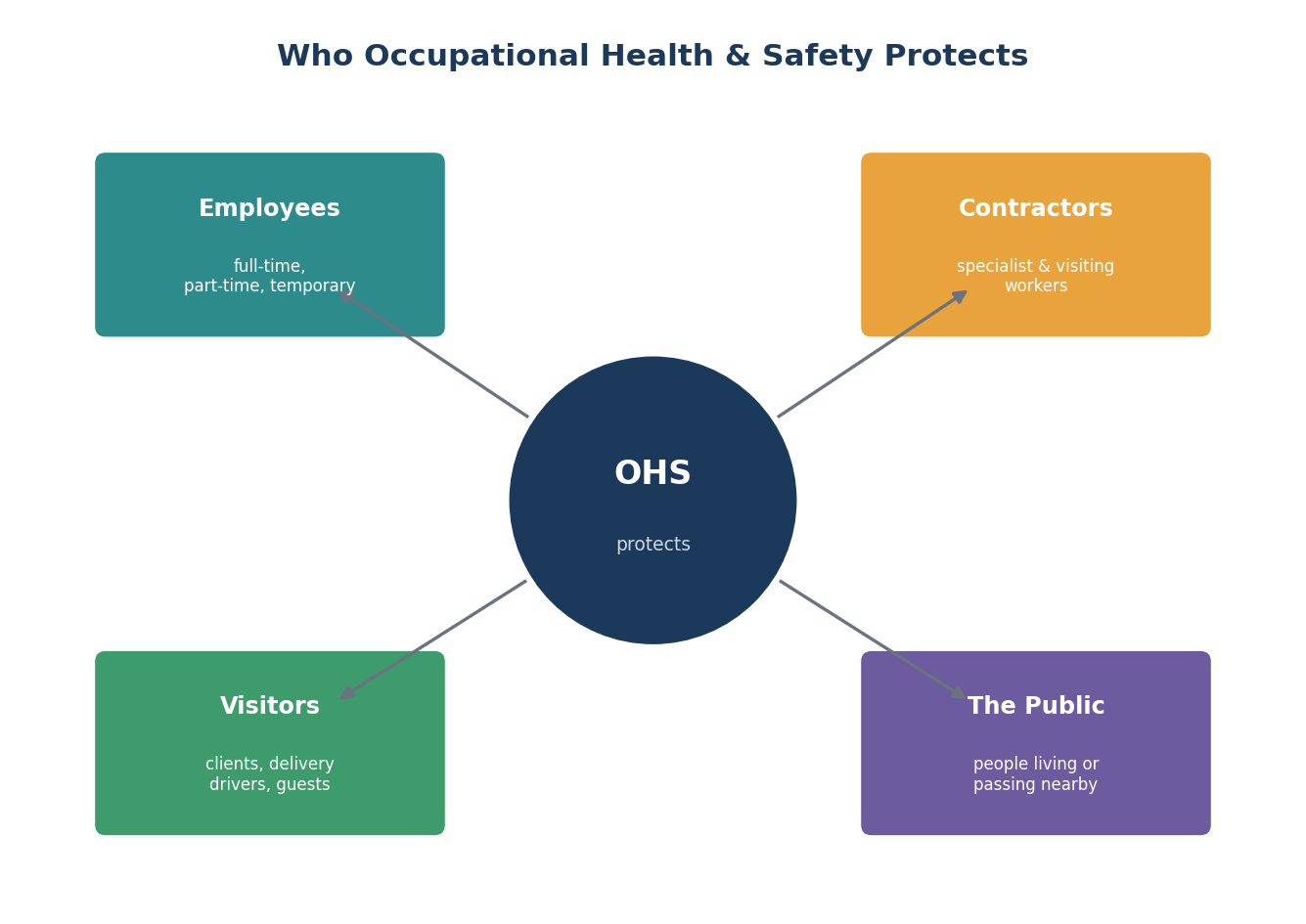
Importantly, occupational health and safety does not only protect direct employees. It reaches every person who might be affected by an organisation’s work activities. This includes full-time and part-time staff, temporary and agency workers, contractors brought in for specialist jobs, visitors and delivery drivers, and even members of the public who live or pass nearby. Understanding this wide scope from the very beginning is essential, because a common cause of serious incidents is an organisation forgetting about the people at the edges — the contractor who did not receive an induction, or the passer-by struck by a falling object.
The International Labour Organization (ILO) and the World Health Organization (WHO) together describe the aim of occupational health as the promotion and maintenance of the highest possible degree of physical, mental and social wellbeing of workers in all occupations. In everyday language, this means that work should not damage a person’s body or mind, and ideally should support their overall wellbeing. A mature OHS approach goes further than simply avoiding accidents: it adapts the work to the worker — designing tasks, tools and workplaces around human capabilities and limits — rather than forcing people to cope with badly designed work.
Finally, occupational health and safety is not a single task, a one-off inspection, or a poster on a wall. It is a continuous, organised activity that is built into the way an organisation plans, carries out and reviews its work. This is precisely why we talk about managing health and safety. Like quality, finance or production, it must be led from the top, given proper resources, monitored against clear standards, and steadily improved over time. That management focus is the theme of this entire course.
Occupational health — protecting people from illness caused or made worse by work (for example hearing loss from noise, or lung disease from dust).
Occupational safety — protecting people from injury caused by an immediate, often sudden event (for example a fall, a cut, or an electric shock).
Welfare — the basic facilities that support wellbeing and dignity at work (for example toilets, washing facilities, drinking water and rest areas).
The words safety, health and welfare are often used together, almost as one phrase, but each describes a different way that work affects people. Being able to tell them apart is more than an academic exercise: it helps you recognise the full range of harm that work can cause, and therefore the full range of controls you may need to put in place. Miss one category, and you leave a gap that can quietly harm people for years.
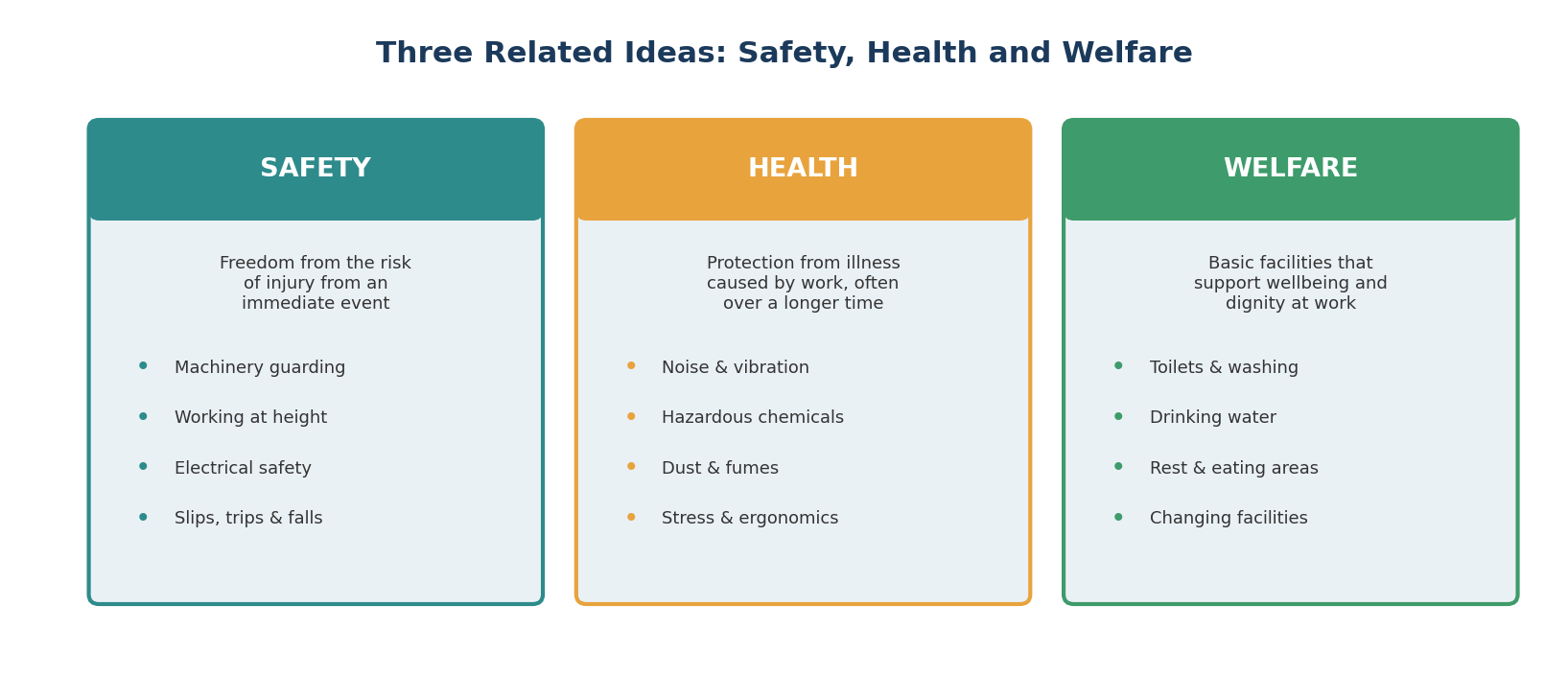
Safety is concerned with avoiding injury from immediate, usually sudden events. The harm happens quickly and its cause is normally easy to see and to link to the event: a worker falls from a ladder and breaks an arm, a hand is drawn into an unguarded machine, a forklift truck strikes a pedestrian, or an electric shock stops a heart. Because the cause and effect are close together in time, safety hazards tend to attract the most attention. This is helpful, but it can also create a blind spot for the slower, quieter dangers.
Health is concerned with avoiding illness caused by work. Here the harm often develops slowly, over months or even years, and may not appear until long after the exposure. Examples include noise-induced hearing loss from years of loud machinery, musculoskeletal injury from repeated manual handling or poor posture, occupational asthma or lung disease from breathing dusts and fumes, and skin disorders from contact with chemicals. Because the effects are delayed and the link to work is less obvious, health risks are easy to underestimate and easy to ignore — which is exactly why they must be managed deliberately and not left to chance. Occupational ill-health, worldwide, causes far more deaths each year than sudden accidents.
Welfare is concerned with the everyday facilities people need to work in reasonable comfort and dignity. This includes clean toilets, somewhere to wash, a supply of drinking water, somewhere to change and store clothing, and a clean place to rest and eat away from the work itself. Good welfare provision is not a luxury or a perk. It supports both physical health (for example, hand-washing reduces the spread of infection and the ingestion of harmful substances) and morale, and in most countries a minimum standard of welfare is a legal requirement. Treating welfare as optional is a clear signal that an organisation does not truly value its people.
Three words sit at the very heart of health and safety: hazard, risk and control. Almost everything else in this course builds on them, so it is worth learning them precisely now. People often use “hazard” and “risk” as if they mean the same thing, but keeping them separate is one of the marks of a competent safety professional.
A hazard is anything with the potential to cause harm. It is a property or a condition, not an event. A wet floor, a moving blade, a loud machine, a toxic chemical, a heavy box, a frayed electrical cable, or a badly designed workstation are all hazards. Notice that a hazard can exist even when no one is being harmed — the potential is simply present, waiting.
A risk is the likelihood that the hazard will actually cause harm, combined with how serious that harm could be. Risk therefore has two parts: how probable is it that someone will be hurt, and how bad would it be if they were? The same hazard can carry very different levels of risk depending on the situation. A sharp blade locked in a drawer is a hazard with a very low risk; the same blade spinning in an unguarded machine in a busy workshop is a hazard with a very high risk. Harm is the actual outcome we are trying to prevent: injury, ill-health, damage or loss.
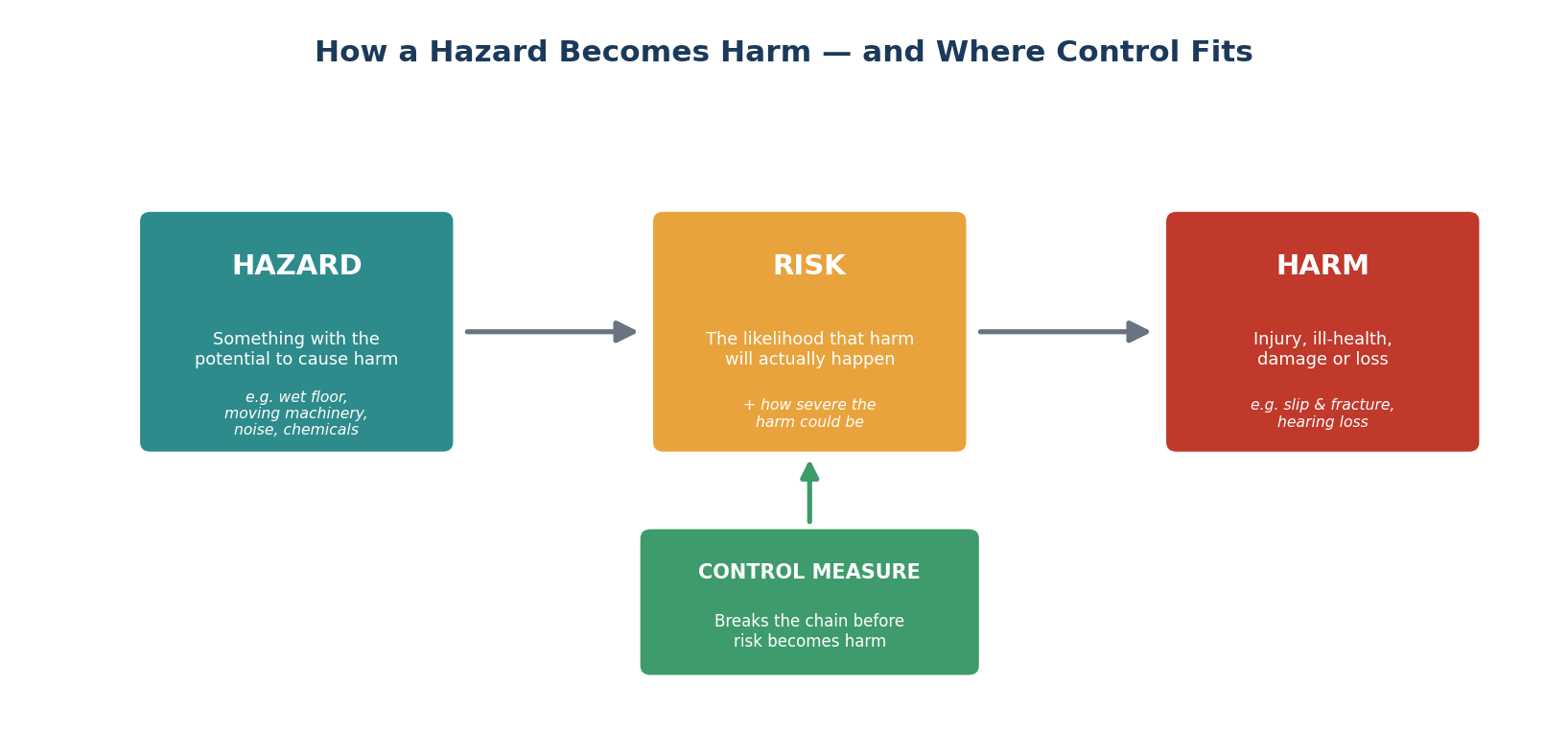
A control (or control measure) is anything we put in place to break this chain — to reduce the risk so that harm does not occur, or is far less likely and far less severe. Mopping and clearly signing a wet floor, fitting a fixed guard to a machine, providing and enforcing hearing protection, training a worker, or redesigning a task to remove heavy lifting are all controls. The entire purpose of health and safety management is to identify hazards, judge the risks, and put suitable controls in place before anyone is harmed.
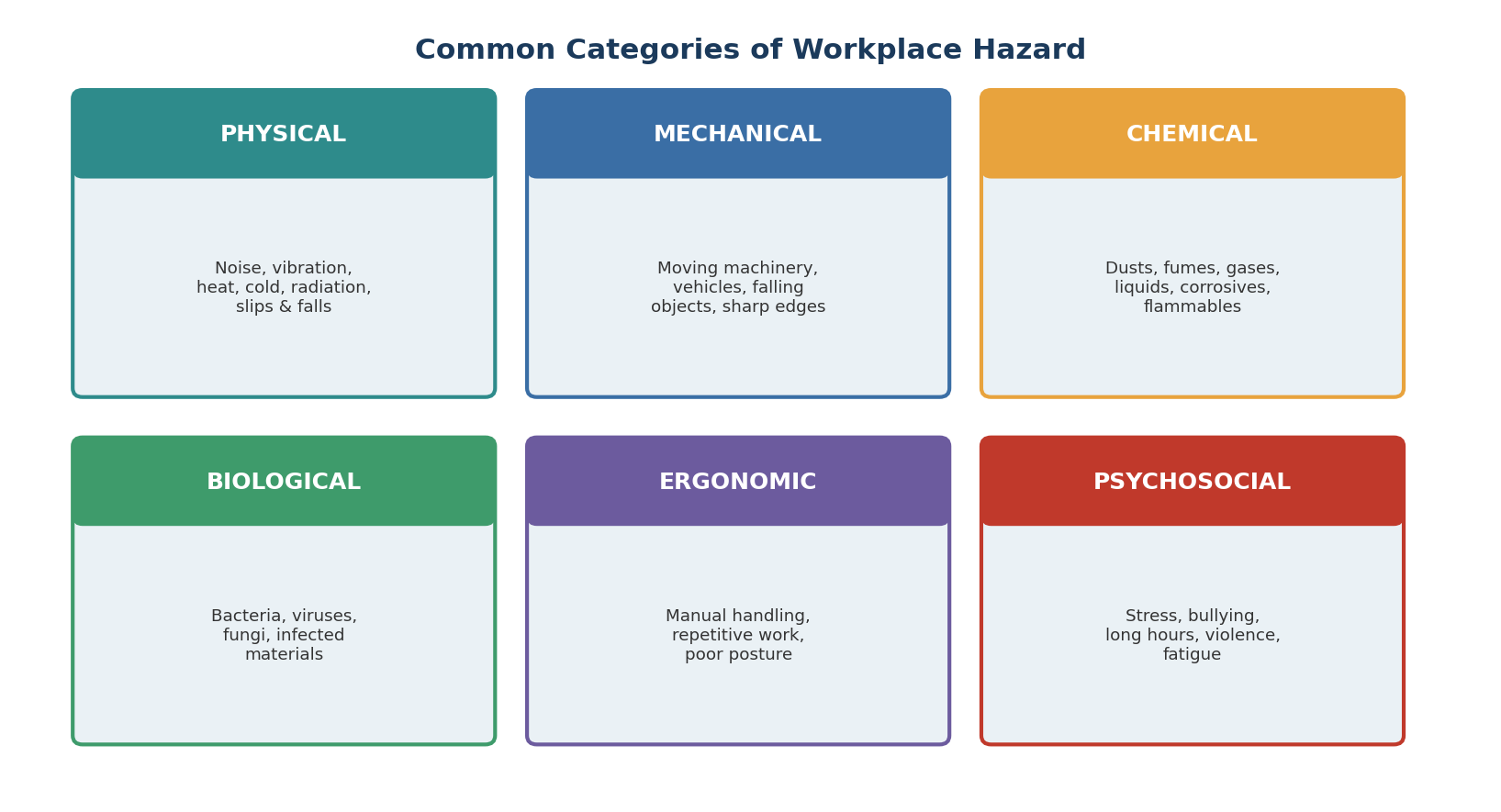
Hazards come in many forms, and grouping them into categories helps make sure none are overlooked when you look at a workplace. The main categories are physical, mechanical, chemical, biological, ergonomic and psychosocial.
A cleaner mops a corridor in a busy office. Hazard: the wet, slippery floor. Risk: people walking through are quite likely to slip, and a fall could cause a serious injury. Control: the cleaner places “wet floor” warning signs, cordons off half the corridor, and mops one side at a time so people always have a dry route. The hazard still exists for a short while, but the risk of harm has been brought right down.
Health and safety is often described as “everyone’s responsibility”, and that is true — but it can be a misleading half-truth if it is left there. Responsibility is real for everyone, yet it is not shared equally. It flows down through an organisation, with the greatest legal and moral duty resting at the top and specific duties attaching to each level below. Understanding this structure helps you see where decisions are made, where they are put into practice, and where they can break down.
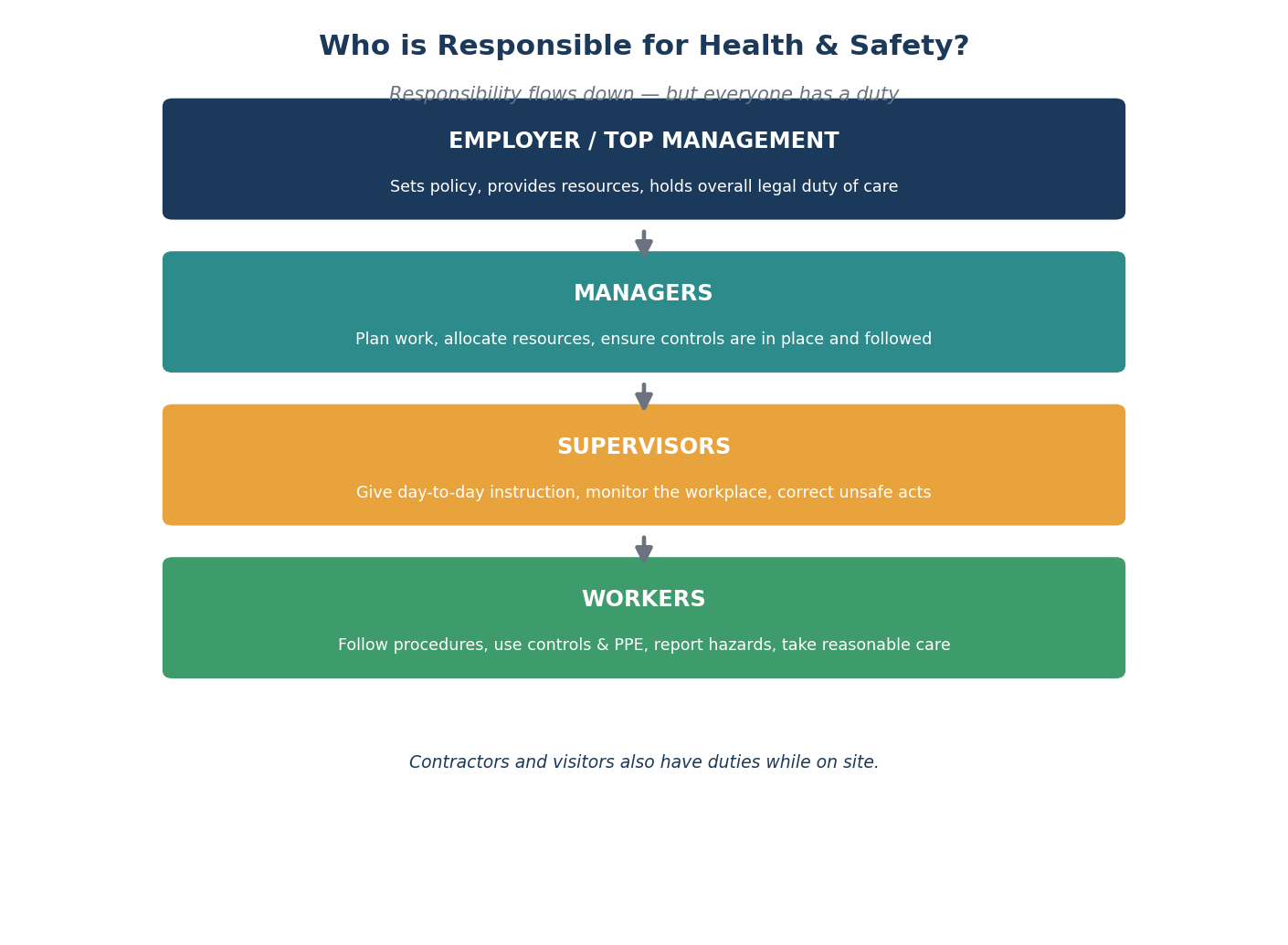
Employers and top management hold the overall duty of care. They decide the organisation’s health and safety policy, set its priorities, and provide the money, people, time and equipment needed to work safely. They are ultimately accountable, in law and in the public eye, if things go seriously wrong. No amount of good intention lower down can fully make up for an employer who refuses to resource safety properly.
Managers translate that policy into everyday action. They plan work so that it can be carried out safely, arrange the right controls, equipment and competent people, set standards for their teams, and check that those standards are being met. Managers are the bridge between the boardroom’s intentions and the reality on the ground; where they are weak or indifferent, policies remain words on paper.
Supervisors are the crucial link to the front line, and their influence is easy to underestimate. They give day-to-day instructions, watch how work is actually being carried out, coach and correct workers, and deal with unsafe acts on the spot. A supervisor who quietly tolerates shortcuts — a missing guard, a skipped check, a removed harness — sends a powerful, wordless message that safety does not really matter. Equally, a supervisor who consistently insists on doing things properly builds a habit of safe working across the whole team.
Workers also carry clear duties. They must follow the procedures and safe systems of work provided, use the control measures and personal protective equipment (PPE) given to them, report hazards, defects and near misses, and take reasonable care for the safety of themselves and others affected by their actions. Finally, contractors and visitors carry duties too while they are on site — they must follow site rules and cooperate with the organisation’s arrangements. Safety works best when every one of these levels understands its part and plays it.
Workplace hazards are broadly similar all over the world. A moving machine is just as dangerous in Lagos as in London; dust harms lungs regardless of the country stamped on a worker’s passport. Because the underlying dangers are universal, international bodies have developed shared standards and good practice that allow organisations in any country to manage health and safety to a recognised, respected level. This is the “international” in the title of this course, and it is one of its greatest strengths.
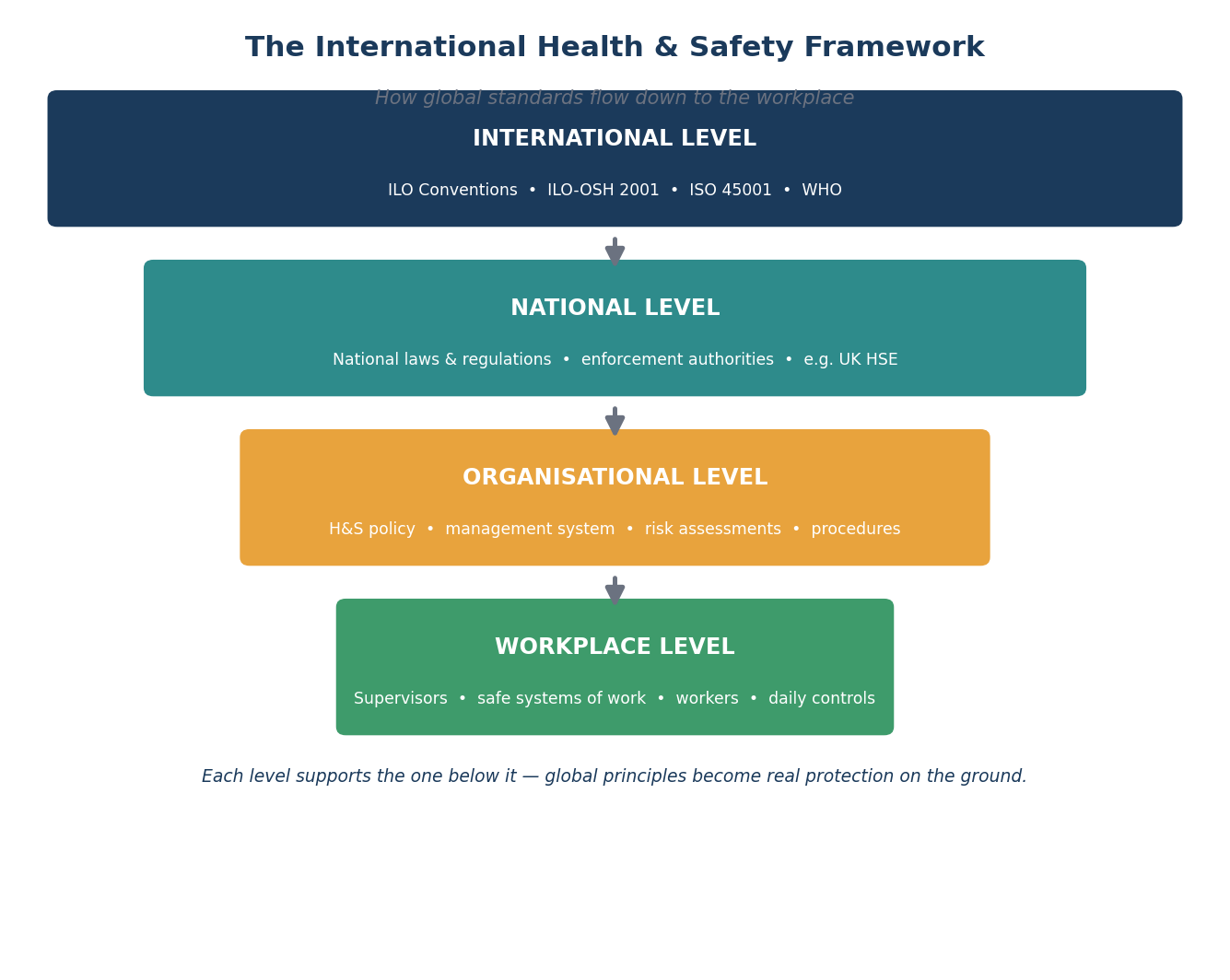
At the international level, the International Labour Organization (ILO) — a specialised agency of the United Nations — sets out conventions and recommendations, and publishes the highly influential guidance ILO-OSH 2001 on occupational safety and health management systems. Alongside it, the International Organization for Standardization publishes ISO 45001, the global standard for occupational health and safety management systems, which organisations can be independently certified against. The World Health Organization (WHO) contributes guidance on occupational health specifically.
At the national level, individual countries pass their own health and safety laws and appoint enforcement authorities to make sure those laws are followed. In the United Kingdom this authority is the Health and Safety Executive (HSE), whose practical guidance is widely respected and used far beyond Britain’s borders. National law is where broad international principles are turned into specific, enforceable duties, backed by inspection and, where necessary, prosecution.
At the organisational level, each employer builds its own health and safety policy, management system, risk assessments and procedures — shaped by the national law it must obey and the international standards it chooses to follow. Finally, at the workplace level, supervisors and workers put all of this into practice through safe systems of work and the daily controls that actually keep people from harm. Each level supports the one below it, so that a principle agreed in Geneva can end up protecting a specific worker on a specific task. This course deliberately follows exactly this logic, teaching you to manage health and safety to international best-practice standards that will serve you in any country.
Look around a workplace you know well. Identify five common workplace hazards. For each one, note which category it belongs to (physical, mechanical, chemical, biological, ergonomic or psychosocial), and write a sentence explaining why it must be controlled — that is, what harm could result if it were left uncontrolled.
Keep your notes. You will build on this skill throughout the course, and it is the foundation of the risk assessment you will complete later.
This lesson explains why health and safety must be managed systematically — through a planned, organised approach — instead of being treated as an informal, hope-for-the-best workplace activity. You will see the four main reasons organisations manage health and safety and why leadership commitment holds it all together.
The first and most important purpose of managing health and safety is prevention — stopping accidents and ill-health before they happen. This may sound obvious, but it marks a genuine shift in mindset. Many workplaces operate reactively, dealing with harm only after it has occurred. A managed approach turns this around and puts the effort in beforehand, where it does the most good and costs the least.
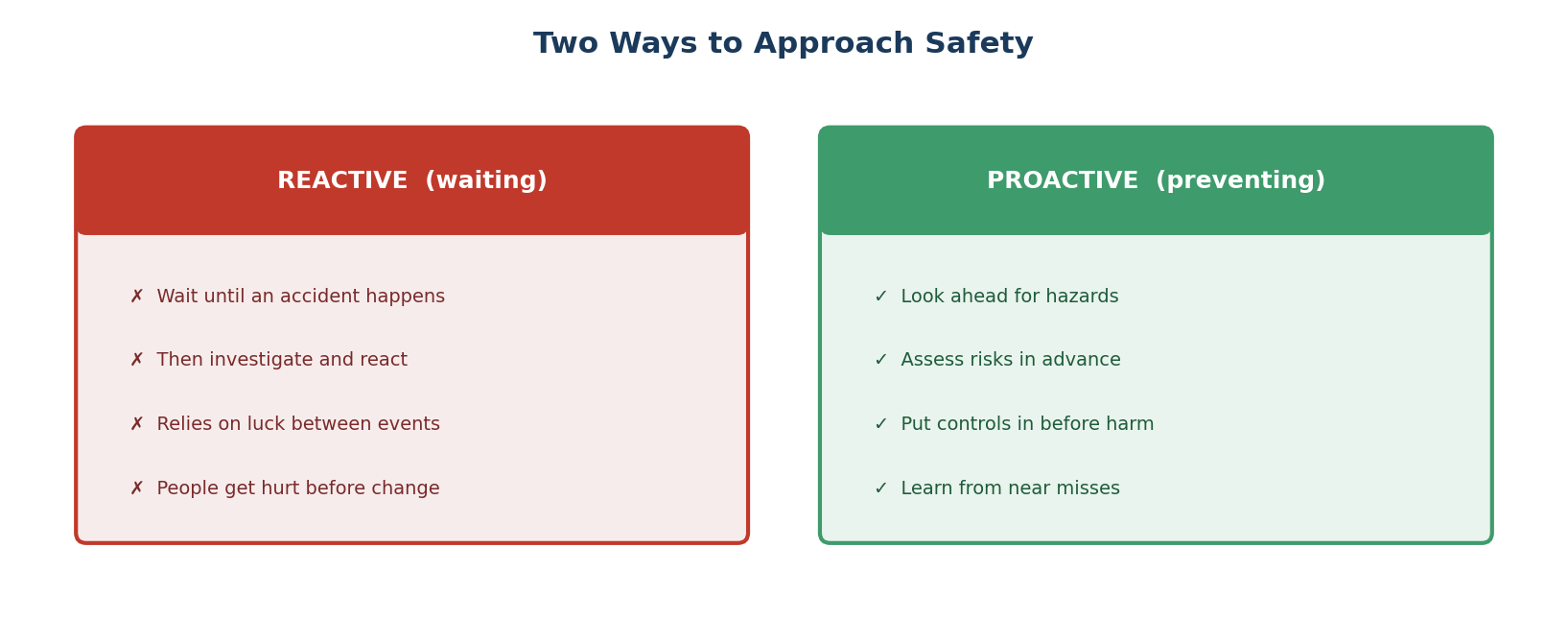
Informal, reactive safety relies on luck. It waits for an accident, then investigates and tries to stop the same thing happening again. The obvious problem is that someone has already been hurt before anything changes — and between incidents, the workplace is simply gambling that nothing will go wrong. Proactive, managed safety works the other way round. It looks ahead, identifies the hazards, judges the risks, and puts controls in place in advance, so that the accident never happens in the first place.
A well-managed approach also makes full use of near misses — events that could have caused harm but happened not to. A dropped tool that missed a worker’s head, a slip that ended in a grab rather than a fall, a spark that did not reach the fuel: each of these is a free warning. Reactive workplaces shrug them off as lucky escapes. Proactive workplaces treat them as valuable information, investigating why they happened and fixing the underlying cause before that same chain of events produces a real injury next time.
Prevention protects people from pain, disability and loss of life, and it protects their families from the consequences. It also saves the organisation the very high — and often hidden — costs that follow every serious incident, which we examine shortly. For all these reasons, prevention is not just one reason to manage health and safety; it is the reason from which the others flow.
A managed health and safety system protects everyone who may be affected by the work, not only the organisation’s direct employees. This includes contractors brought in for specialist or short-term tasks, agency and temporary staff, visitors and delivery drivers, and sometimes members of the public living or moving nearby. A key strength of a system, as opposed to informal care, is that it is designed to catch these groups rather than forget them.
This matters enormously, because these groups are frequently more at risk than experienced permanent staff, not less. A contractor may be highly skilled at their trade but completely unfamiliar with the specific hazards of your site — where the buried cables run, which valve is live, how the traffic flows. A visitor may innocently wander into a dangerous area simply because no one told them not to. A new, young or temporary worker may not yet recognise dangers that long-serving staff avoid almost without thinking. Unfamiliarity, in other words, is itself a hazard.
A formal system addresses this by making sure that induction, information, instruction, training and supervision reach all of these people before they are exposed to risk. It ensures contractors are given site rules and their work is coordinated with the organisation’s own activities; that visitors are signed in, briefed and escorted where necessary; and that new and young workers receive extra supervision until they are competent. The aim is straightforward but powerful: being unfamiliar with a workplace should never become the reason a person is harmed by it. Where organisations neglect this, it is very often a contractor or a visitor — someone at the edge of the system — who pays the price.
Managing health and safety is not only the morally right thing to do — it also keeps the organisation running smoothly and profitably. This is the argument from business continuity and operational efficiency, and it is often the argument that persuades those who control the budget. Far from being a cost that competes with productivity, good safety management supports it.
A serious accident disrupts everything at once. Work may have to stop entirely while the scene is made safe and investigated. Equipment may be damaged, destroyed, or seized as evidence. Skilled workers may be absent through injury, or replaced at short notice by less experienced staff who work more slowly and make more mistakes. Deadlines slip, orders are missed, customers are let down and may take their business elsewhere, and insurance premiums rise for years afterwards. A single major incident can undo months of careful work in an afternoon.
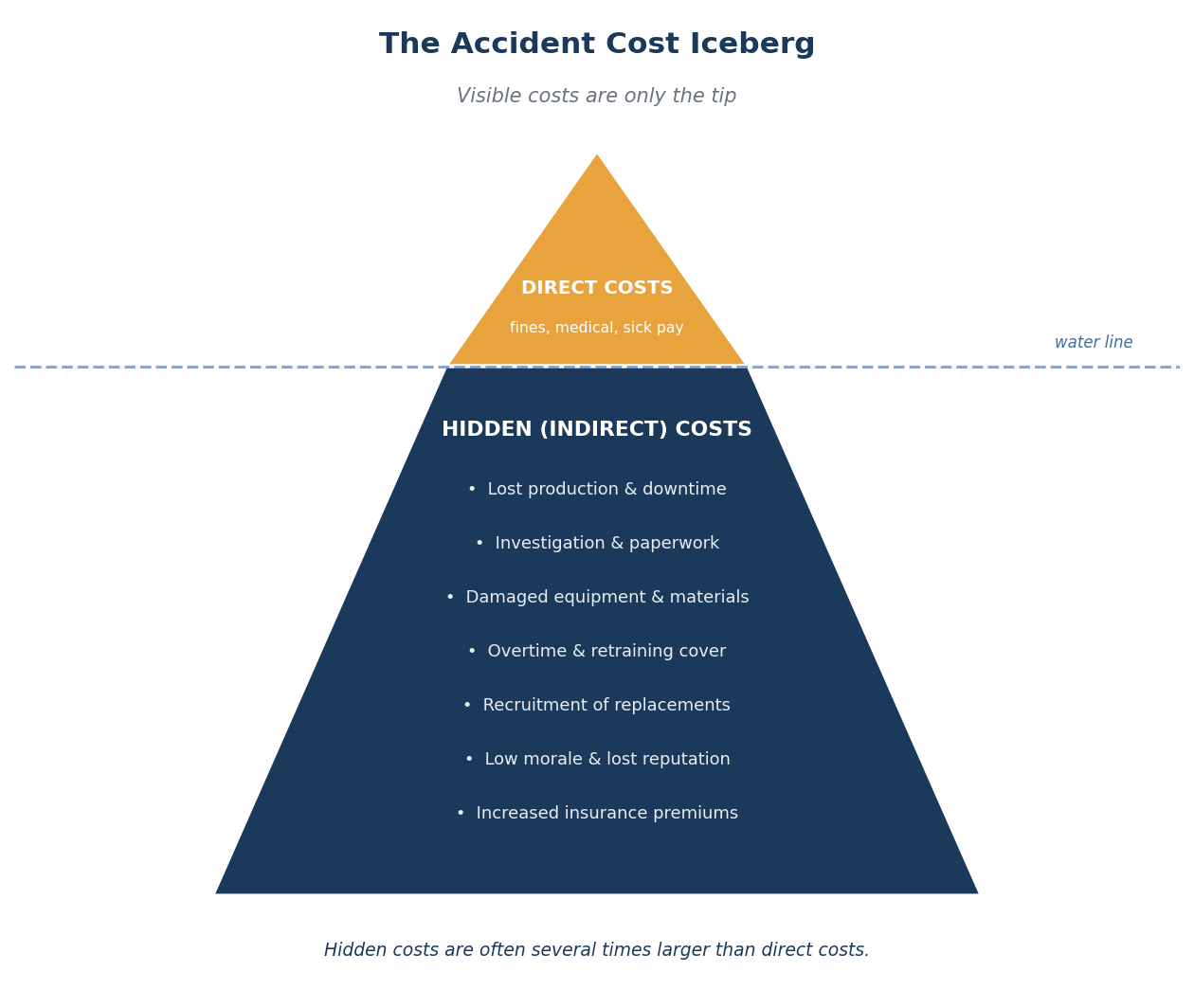
This leads to one of the most important ideas in health and safety economics: the accident cost iceberg. The direct costs of an accident — a fine, a medical bill, sick pay — are only the visible tip. Beneath the surface lie far larger indirect or hidden costs: lost production time, the hours spent investigating and completing paperwork, damaged equipment and materials, overtime and retraining to cover the gap, recruitment of replacements, lowered morale, and lost business reputation. Studies consistently find these hidden costs to be several times greater than the direct ones. By contrast, a well-managed workplace runs more predictably, with fewer interruptions, less lost time, lower staff turnover and better-quality output. Safety and productivity, properly understood, are partners rather than rivals.
An organisation’s reputation is one of its most valuable and most fragile assets, and health and safety has a direct and lasting effect on it. Reputation is built slowly, over years of reliable behaviour, but it can be badly damaged in a single day. A serious incident — especially one that kills or seriously injures a worker or a member of the public — can generate headlines, investigations and public anger that follow an organisation for a very long time, long after any fine has been paid.
A strong safety record, on the other hand, builds trust with many different groups simultaneously, and that trust has real commercial value. Workers are more loyal, more motivated and easier to recruit and retain when they know the organisation genuinely looks after them; skilled people increasingly choose employers by reputation. Clients and business partners increasingly demand proof of good safety management before they will award contracts — in many industries, a poor safety record now simply disqualifies a company from bidding at all. Regulators tend to take a more cooperative, less adversarial view of organisations that visibly take their duties seriously, while focusing their enforcement attention on those that do not.
In this way, good health and safety management protects and strengthens the organisation’s standing in the eyes of everyone it deals with: its own people, its customers, its suppliers, its regulators, its investors and the wider public. Reputation is not a “soft” extra benefit sitting to one side of safety — it is woven directly into the organisation’s ability to attract talent, win work and operate without interference. Managing health and safety well is, in the end, part of managing the business well.
None of the benefits described in this lesson — prevention, protection, continuity or reputation — happen on their own. They all depend on leadership. Decades of experience and investigation into major disasters point to the same conclusion: health and safety ultimately succeeds or fails on the commitment shown by those at the top of the organisation. Where that commitment is genuine, systems work; where it is absent or merely for show, systems slowly rot no matter how good they look on paper.
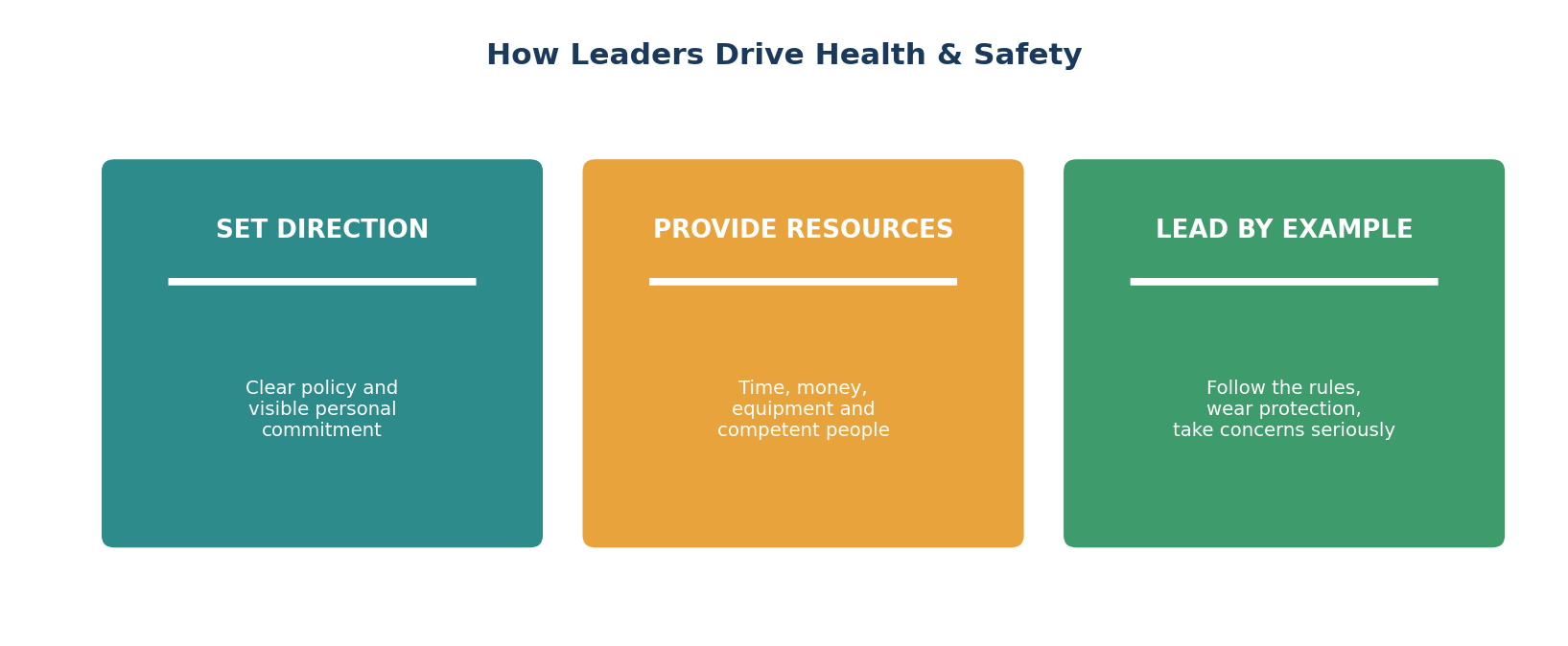
Leaders shape the safety of their organisation in three main ways. First, they set the direction — through a clear, honest health and safety policy and, just as importantly, through visible personal commitment that shows the policy is meant. Second, they provide the resources — the time, money, equipment and competent people without which safe working is simply impossible. A leader who demands safety but refuses to fund it is not really committed at all.
Third, and most powerfully of all, leaders set the example. People watch what their bosses do far more closely than they listen to what their bosses say. When senior managers follow the rules themselves, wear the required protective equipment even on a quick site visit, stop to deal with a hazard, and take reported concerns seriously, that behaviour ripples outward and becomes the norm. When leaders cut corners, wave away concerns, or treat safety as a box-ticking chore that slows “real” work, that attitude spreads just as quickly and just as far.
This is why genuine leadership commitment is the single most important factor in a positive health and safety culture — the shared set of attitudes and behaviours that determines how an organisation really treats safety when no one is watching. We will return to culture in detail later in the course, but the foundation is laid here: informal, leaderless safety is not enough. A systematic approach, driven from the top, sets clear responsibilities, identifies hazards in advance, puts controls in place, checks that they work, and improves over time. It does not depend on any one worker happening to remember to be careful on a busy, tired, distracted day. That is the difference between merely hoping to be safe and being properly organised to be safe.
Telling workers to “be careful” places the whole burden on individuals and leaves no plan for when things go wrong. A systematic approach — a managed system — sets clear responsibilities, identifies hazards in advance, puts controls in place, checks that they work, and improves over time. It does not depend on any one person remembering to be careful on a busy day. This is the difference between hoping to be safe and being organised to be safe.
Write a short explanation (about one paragraph) of why your workplace needs a formal health and safety system. Use at least three of the reasons from this lesson — prevention, protection, business continuity, reputation, or leadership responsibility — and give a real example from your own workplace for each one you choose.
Module 1 Summary
In this foundation module you built the vocabulary and the reasoning that the rest of the course depends on. You learned that occupational health and safety is the organised protection of everyone affected by work, and that safety (immediate injury), health (illness over time) and welfare (basic facilities) are related but distinct. You followed the chain from hazard to risk to harm, saw how a control breaks that chain, and met the main categories of hazard. You saw how responsibility flows from employers through managers and supervisors to workers, and how international standards from the ILO, ISO and WHO, together with national authorities like the UK HSE, shape practice everywhere.
You then learned why we manage health and safety systematically: to prevent harm, to protect everyone affected, to maintain business continuity, and to safeguard reputation — all of which rest on genuine leadership commitment. In the next module, we examine the first NEBOSH syllabus element in depth: the moral, legal and financial reasons for managing workplace health and safety.
Hazard (potential to cause harm) • Risk (likelihood × severity of harm) • Harm (actual injury, ill-health or loss) • Control (measure that reduces risk) • Safety / Health / Welfare • Duty of care • Near miss • Cost iceberg • Systematic management
Curriculum
Foundations
- 🎬 Lesson 1.2: The Purpose of Managing Workplace Health and Safety
- 📝 Module 1 Quiz: Introduction to International Health and Safety Management
Why We Should Manage Workplace Health and Safety
- 🎬 Lesson 2.1: Moral Reasons for Managing Health and Safety
- 🎬 Lesson 2.2: Financial Reasons for Managing Health and Safety
- 🎬 Lesson 2.3: Legal Reasons for Managing Health and Safety
- 🎬 Lesson 2.4: How Health and Safety Is Regulated
- 🎬 Lesson 2.5: Main Health and Safety Duties of Different Groups
- 🎬 Lesson 2.6: Contractor Selection, Control and Management
- 📝 Module 2 Quiz: Why We Should Manage Workplace Health and Safety
Health & Safety Management Systems
In the previous module, we answered the question of why workplace health and safety must be managed. This module now focuses on how health and safety is managed effectively. Good intentions alone are not enough to keep people safe. Organisations need an organised and systematic approach to managing health and safety. In this module, you will learn what a health and safety management system is, the key components that make it effective, and the international frameworks that guide good practice around the world. You will be introduced to two important frameworks: ISO 45001 and ILO-OSH 2001. You will also study the role of the health and safety policy, how responsibilities are assigned, and how accountability is established so that the safety management system works in practice. Throughout the module, the Plan-Do-Check-Act cycle will be used to show how all parts of the system connect and support continual improvement. LESSONS IN THIS MODULE Lesson 3.1: Introduction to Health and Safety Management Systems Lesson 3.2: Key Components of an Effective Safety Management System Lesson 3.3: ISO 45001 and International Safety Management Principles Lesson 3.4: ILO-OSH 2001 and International Good Practice Lesson 3.5: Health and Safety Policy Lesson 3.6: Roles, Responsibilities and Accountability in the Safety System Each lesson includes a video introduction, detailed learning content with diagrams, a practical activity, and knowledge-check questions. The module concludes with a module assessment to test your understanding.
- 🎬 Introduction to Health and Safety Management Systems
- 🎬 Key Components of an Effective Safety Management System
- 🎬 ISO 45001 and International Safety Management Principles
- 🎬 ILO-OSH 2001 and International Good Practice
- 🎬 Health and Safety Policy
- 🎬 Roles, Responsibilities and Accountability in the Safety System
- 📝 Module Practical Quiz
Managing Risk - Understanding People and Processes
- 🎬 Lesson 4.1: Health and Safety Culture
- 🎬 Lesson 4.2: Improving Health and Safety Culture
- 🎬 Lesson 4.3: Human Factors in Health and Safety
- 🎬 Lesson 4.4: Risk Assessment Principles
- 🎬 Lesson 4.5: The Five Steps of Risk Assessment
- 🎬 Lesson 4.6: Hierarchy of Control
- 🎬 Lesson 4.7: Safe Systems of Work
- 🎬 Lesson 4.8: Permit-to-Work Systems
- 🎬 Lesson 4.9: Management of Change
- 🎬 Lesson 4.10: Emergency Procedures and First Aid Arrangements
- 📝 Quiz 4.1: Health and Safety Culture
- 📝 Quiz 4.2: Improving Health and Safety Culture
- 📝 Quiz 4.3: Human Factors in Health and Safety
- 📝 Quiz 4.4: Risk Assessment Principles
- 📝 Quiz 4.5: The Five Steps of Risk Assessment
- 📝 Quiz 4.6: Hierarchy of Control
- 📝 Quiz 4.7: Safe Systems of Work
- 📝 Quiz 4.8: Permit-to-Work Systems
- 📝 Quiz 4.9: Management of Change
- 📝 Quiz 4.10: Emergency Procedures and First Aid Arrangements
Health & Safety Monitoring and Measuring
- 🎬 Lesson 5.1: Introduction to Health and Safety Performance Monitoring
- 🎬 Lesson 5.2: Active Monitoring Methods
- 🎬 Lesson 5.3: Reactive Monitoring Methods
- 🎬 Lesson 5.4: Incident Reporting, Recording and Investigation
- 🎬 Lesson 5.5: Incident Investigation Process
- 🎬 Lesson 5.6: Health and Safety Auditing
- 🎬 Lesson 5.7: Review of Health and Safety Performance
- 📝 Quiz 5.1: Introduction to Health and Safety Performance Monitoring
- 📝 Quiz 5.2: Active Monitoring Methods
- 📝 Quiz 5.3: Reactive Monitoring Methods
- 📝 Quiz 5.4: Incident Reporting, Recording and Investigation
- 📝 Quiz 5.5: Incident Investigation Process
- 📝 Quiz 5.6: Health and Safety Auditing
- 📝 Quiz 5.7: Review of Health and Safety Performance
Examination Preparation
- 🎬 Lesson 6.1: Understanding the Open-Book Examination
- 🎬 Lesson 6.2: NEBOSH Command Words
- 🎬 Lesson 6.3: How to Answer Scenario-Based Questions
- 🎬 Lesson 6.4: Final Mock Scenario Assessment
- 📝 Quiz 6.1: Understanding the Open-Book Examination
- 📝 Quiz 6.2: NEBOSH Command Words
- 📝 Quiz 6.3: How to Answer Scenario-Based Questions
- 📝 Quiz 6.4: Final Mock Scenario Assessment
Practical Risk Assessment Bridge
- 🎬 Lesson 7.1: Linking Management Knowledge to Practical Risk Assessment
- 🎬 Lesson 7.2: Preparing an Action Plan
- 📝 Quiz 7.2: Preparing an Action Plan
- 📝 Quiz 7.1: Linking Management Knowledge to Practical Risk Assessment